MHT Induction Lighting

MHT Lighting manufactures the highest quality, energy saving Induction, LED and power management systems for commercial industrial, and government applications.

Induction Lighting

MHT Lighting has taken Induction Lighting to the next level by incorporating quality manufacturing, value-added innovations, fixture design and Smart Controls to enhance the capabilities of Induction Lighting to make it the best solution for your investment in energy efficient technology.

Led Lighting

MHT Lighting has developed innovative LED products including products incorporating patent pending technologies. Our LED products are easy to install with faster ROI’s than are common in the market place.

Monday, 16 December 2013

Induction lighting Vs. LED lighting

Energy management system and energy efficient lighting solution is at a ramp up stage with new innovations hitting the market at a revolutionary speed. You might have seen or heard about induction lighting and would have certainly seen LED flat panels and LED tubes in gas station lights or parking garage lights. The perplexity may arise when you have to decide between LED and induction light.

Understanding the disparity

For big industrialists, easy maintenance and cost effectiveness may be the parameters to be considered while selecting the lighting, but for common populace life span and bright light may be much significant factors along with the price.

Life: Both induction and LED lights have almost similar life span of 80,000 to 100,000 hours depending upon the type and model of the product but LED lights are still costlier than induction lights.

Conversion Efficacy: LED lights have energy efficacy of 35-55 lumen/watt. Some expensive models may also have 70-75 lumen/watt efficacies whereas induction lights have conversion efficacy ranging between 65-82 lumen/watt. To put it simple, for a 200 watt fixture LED may produce only 11,00 lumen as compared to 16,000 lumen of induction light which means 31% more light.

Cost: To make an LED light fixture for 200 W, an array of LED is used and that may cost 50 to 70% more than the induction lamp that use similar technology as of fluorescent lights to reduce the cost. However, mass production of LED may erase the cost gap in future.

Purposefulness: Light emitting diodes or LEDs are not considered as general purpose lighting because it has poor color rendering index and limited lighting. On the other hand, induction lights are available with same life span, higher wattage and brighter light. Induction lights are surely the next revolutionary and efficient lighting solution.
3 Common Myths of LED Lighting

Most changes come along with resistance and lighting is no exception! Though LED lighting has made its mark in office lights, gas station lights, parking garage lights and industry lighting, common populace may still have some resistance to switch from CFLs or candescent bulbs to new and innovative LED tubes or LED flat panels. Following are the 3 most common myths people generally have resisting them to adapt LED lights:

1. Less brighter as compared to candescent bulb

This myth may arise out of misinformation or just a bad experience and it is not at all true. Back in the time with candescent bulbs, the brightness of the light was associated with the wattage, more wattage means brighter light, but this is not the case with LED lights. LEDs consume less wattage for more output. A 29W LED light may produce 2600 lumens unit of light) that would give brightness as much as 150 Watt candescent bulbs.

2. LED produces bluish white light

Another myth associated with LED lights is that they have white light with tones of blue which is not true with every LED lamp. LED lights are available in wide variety of color temperature to determine their colors. You can choose among 3500K-6500K color temperature for bluish light or between 2700-3000K color temperatures for familiar white light.

3. LED lights are costly

Apparently, this is true that initial cost of LED light is high but another truth is that the cost of any kind of lighting shall not just be determined by the initial purchase cost. It should rather include initial cost + maintenance cost + replacement cost. LED lights are zero maintenance and have 20 times more life (100,000 hours or 25 years if used for 10 hours/day) than other traditional lighting options. Moreover, LED lights come with longer period of warranty, so you decide!

Discovery of led lights

discovery of led lights
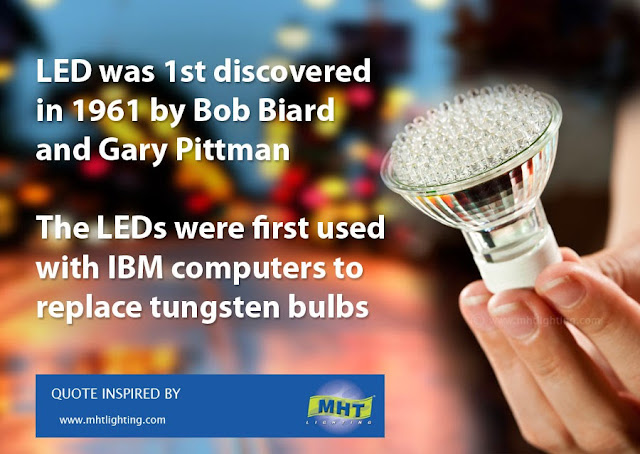
  •  LED was 1st discovered in 1961 by Bob Biard and Gary Pittman
  • The LEDs were first used with IBM computers to replace tungsten bulbs

uses of led lights in home

uses of led lights in home
  • LED is tougher than a bulb with filament
  • It is resistant to vibration and sudden impacts
  • LED uses semiconductors and electroluminescence to create light

Key benefits of LED’s

Key benefits of LED’s
  • Typical LED requires only 30-60 milliwatts to operate
  • Durable and shockproof unlike glass bulb lamp
  • Reduces stray light pollution on streetlights

Friday, 6 December 2013

3 Common Myths of LED Lighting

Most changes come along with resistance and lighting is no exception! Though LED lighting has made its mark in office lights, gas station lights, parking garage lights and industry lighting, common populace may still have some resistance to switch from CFLs or candescent bulbs to new and innovative LED tubes or LED flat panels. Following are the 3 most common myths people generally have resisting them to adapt LED lights:

1. Less brighter as compared to candescent bulb
This myth may arise out of misinformation or just a bad experience and it is not at all true. Back in the time with candescent bulbs, the brightness of the light was associated with the wattage, more wattage means brighter light, but this is not the case with LED lights. LEDs consume less wattage for more output. A 29W LED light may produce 2600 lumens unit of light) that would give brightness as much as 150 Watt candescent bulbs.

2. LED produces bluish white light
Another myth associated with LED lights is that they have white light with tones of blue which is not true with every LED lamp. LED lights are available in wide variety of color temperature to determine their colors. You can choose among 3500K-6500K color temperature for bluish light or between 2700-3000K color temperatures for familiar white light.

3. LED lights are costly
Apparently, this is true that initial cost of LED light is high but another truth is that the cost of any kind of lighting shall not just be determined by the initial purchase cost. It should rather include initial cost + maintenance cost + replacement cost. LED lights are zero maintenance and have 20 times more life (100,000 hours or 25 years if used for 10 hours/day) than other traditional lighting options. Moreover, LED lights come with longer period of warranty, so you decide!

Energy Management with SP1000

SP1000 is the most advanced and efficient energy management system, which is used for big industries to manage the energy consumptions and wastage. The energy costs are sky rocketing all around the world; SP1000 brings the best of technology to allow you having a peaceful breath.

SP1000 has endless opportunity with hybrid system that can take plenty of decisions and can also suggest ways to save energy with enhanced load carrying capabilities. Not only this but this equipment also has software to show up the saving actions as it maintains the power level through all your facility.

Demand Charge Saving With SP1000

While most people struggle to manage their kilowatt consumption of power, it is not in their slightest realization that a major part of their bill is “demand” cost (almost 35%). Demand power is the peak Kilowatts that you consume or is required in the peak hours of a day. SP1000 can greatly reduce this demand cost by 68% through proper power management and no wastage. Thus, you can largely reduce your monthly bills.

Other benefits of SP100

Apart from saving large on demand cost, SP1000 can also benefit in following ways:
•    Enhanced capability of carrying load within the existing circuits
•    Enhanced voltage throughout
•    Reduction in carbon footprint
•    Improved balance
•    Reduced harmonic
•    Reduced negative energy
•    Reduced KWH
•    Reduced back current in neutral lines
•    Helps in identification of maintenance issues
•    Access the data remotely
•    Real time system parameters
•    Can store data for up to 2 years

Applications of SP1000

SP1000 system can be used in locations of power consumption units such as:
•    Factories
•    Hospitals
•    Airports
•    Industries
•    Hotels
•    High rise offices
•    Elevators
•    Compressors
•    HVAC
•    Super markets
•    Water pumps

With SP1000, you can stay proactive in your approach to identify and rectify any maintenance issues rather than being just reactive.