MHT Induction Lighting

MHT Lighting manufactures the highest quality, energy saving Induction, LED and power management systems for commercial industrial, and government applications.

Induction Lighting

MHT Lighting has taken Induction Lighting to the next level by incorporating quality manufacturing, value-added innovations, fixture design and Smart Controls to enhance the capabilities of Induction Lighting to make it the best solution for your investment in energy efficient technology.

Led Lighting

MHT Lighting has developed innovative LED products including products incorporating patent pending technologies. Our LED products are easy to install with faster ROI’s than are common in the market place.

Wednesday, 3 February 2016

Understanding Power Factor Correction and Its Benefits

By Kyle Leighton, NAME Energy Group 

2/03/2016

What is Power Factor?

In order to understand what power factor correction is and how energy can be saved… electrical energy, or power factor, needs to be defined. Electrical energy is made up of voltage and it’s current; think of water running in a river. The river symbolizes how big the voltage is, and the current is how fast the river is moving. The actual energy or “power factor” is the multiplication of both voltage times current. However, while there could be a strong flow, the water could be going in various directions like a river. If the water is moving strongly, but going sideways, it is not going to benefit the stream just like a running electrical current that requires correction will not benefit its application.
That’s what power factor is, and how it can be measured. It is the synchronicity between the voltage and current, and whether or not they are going the same direction.

Where Does the Power Go?

A Limnologist cannot look at a river and not care about how much water is in it or in which direction it is moving because of the effect it has on the ecosystem. In this case, building managers and electrical engineers need to know what direction their power is going and how much of it is being used efficiently because of the effect it has on the application. A high power factor would mean that there is an efficient utilization of electrical power and a low power factor would mean that there is a poor utilization of electrical power.
The problem is that typically 50% of energy is wasted in power lines without electrical professionals even realizing it.


Power Factor Correction

So how can the river flow in the right direction and what would that mean?
An energy management system would need to be installed that would fit the application in order to compensate for the reactive power required by the electrical energy. The size of the system would change as a function of the active power required by the installation, the current power factor, and the power factor required so that the "river could flow" the most efficient way possible and enable the power factor to become much lower.
Most electric utility companies charge for maximum metered usage based on either the highest registered demand in kilowatts (KW meter), or a percentage of the highest registered demand in KVA (KVA meter), whichever is greater. In other words, if electrical power is being lost in electrical lines because of a high power factor, electrical bills will be much higher.
If the power factor is corrected or "lowered", the percentage of the measured KVA will be significantly greater than the KW demand. Improving the power factor through the use of an energy management system will therefore lower demand charges because electrical energy will be used efficiently resulting in reduced electricity bills, and a far more efficient "river".


Original Article: http://hubpages.com/technology/Understanding-Power-Factor-Correction-and-Its-Benefits
Thursday, 2 January 2014

HPS Lights vs LED Lights

HPS Lights vs LED Lights
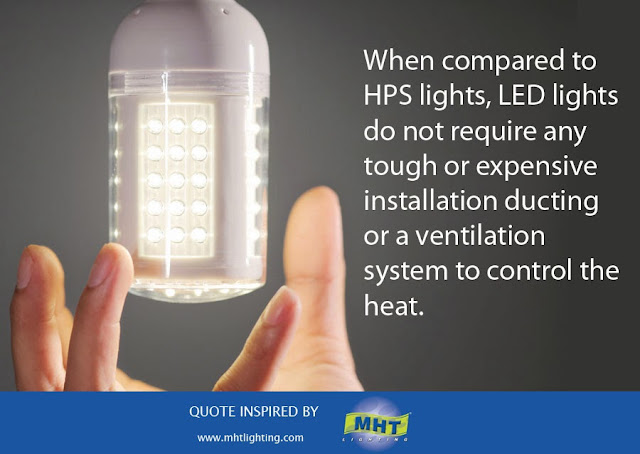
When compared to HPS lights, LED lights do not require any tough or expensive installation ducting or a ventilation system to control the heat.

Wednesday, 1 January 2014

LED Grow Light

LED grow light
LED grow light technology plays key role in the cultivation of marijuana medicinal plants that used to treat eye ailments.

Tuesday, 31 December 2013

LED aquarium lights

LED aquarium lights
LED aquarium lights are developed to meet the necessities of corals such as SPS, LPS grown in marine reef tanks.

Monday, 30 December 2013

LED light Vs HPS Light

LED light Vs HPS Light
  • LED Lights requires less electricity to that of HPS [High pressure sodium] lights
  • HPS lights produce more heat than LED lights

Saturday, 28 December 2013

LED grow lights

LED grow lights
Most of the unwanted yellow light is eliminated by LED grow lights as they have lower wattage draw and heat output. Thus, they give the plants the ideal spectrum for growth and flowering.

Friday, 27 December 2013

Energy Consumption for Lighting

Energy Consumption
The Department of Energy has forecasted that LED lighting will possibly reduce 29% of overall energy consumption for lighting in the U.S by the fall of 2025.

Thursday, 26 December 2013

Did you know about Induction lighting?

Induction lighting
  • Induction Lighting has been utilized widely in Asia, Australia, and Europe
  • It lasts longer with no electrodes in it
  • Life span is greater than fluorescent lights

Wednesday, 25 December 2013

LED Edge Lit Panels

LED Edge Lit Panels
LED Edge Lit Panels is exclusively designed for drop ceilings

It replaces fluorescent fixtures in –
  • Commercial buildings
  • Schools
  • Hospitality and more…

Tuesday, 24 December 2013

How safe is LED?

How safe is LED?
  • No qualms about breakable glass or filaments
  • Highly resistant to shock and vibration
  • Reduces recycling cost

Monday, 23 December 2013

Eco-friendly LED’s

Eco-friendly LED
  • LED Lighting is non-toxic. It contains no mercury, lead, or cadmium
  • LED is recyclable
  • Produces no light pollution and complies with DARK SKY initiatives

Wednesday, 18 December 2013

Induction Lighting Perks

Induction Lighting Perks
Induction lighting perks –
  • Street Lighting
  • Warehouses
  • Hospitals and Schools
  • Tennis Courts
  • Exhibition Halls and even more...

Monday, 16 December 2013

LED finds wide application

LED Lighting

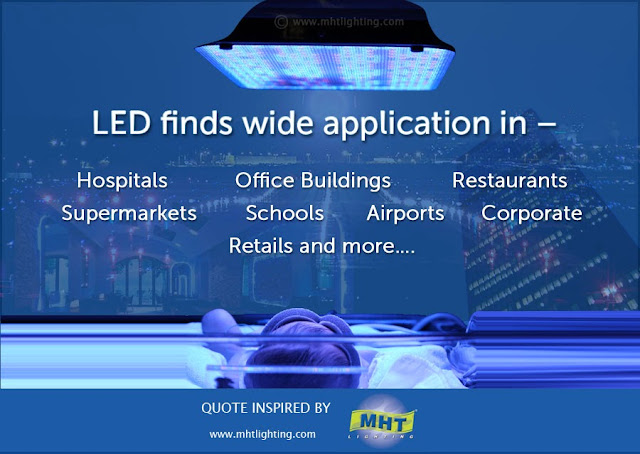
LED finds wide application in -

Hospitals
Office Buildings
Restaurants
Supermarkets
Schools
Airports
Corporate
Retails and more….

led power consumption

led power consumption
  • According to the U.S. Department of Energy, LED's use 75% less energy than traditional incandescent bulbs
  • LED’s release very less heat

Parking Garage Lights: Light up your Future

Had you ever thought that parking garage lights and revolution can come together in a single sentence? Think again!

Advanced technology of LED lighting and Induction lighting is spelling revolution for gas station lights and parking garages lights. No, not just the very decorative LED flat panels on the ceiling or efficient LED tubes on the station and not even the flashy spot lights to direct the way. It is much bigger and advanced.

Shine on Demand

LED and induction lights are already known to be energy efficient and bill reducing, but these lighting systems are now revolutionized with several sensors to perform smartly. They can switch on and off as on demand and thus can save further on electricity bills. It can automatically switch on when the natural light fades away and can wait in a dimmer mode when no action or occupant is sensed.

Advantages of Smart Lighting

Such innovative and power saving lighting systems deserve to be called intelligent or smart as it not only improves the night time visibility but also caters to different lighting requirements at various levels. Such innovative lighting systems can have endless advantages and best out of such are listed here:
  • Hassle free operation with automatic on and off switching by sensing the light
  • Has long life span to serve for as long as 100,000 hours or 25 years if used for 10 hours per day
  • Very less maintenance
  • Low cost of operation
  • Change in the intensity of the light can alert pedestrians and other crew
  • Consumes 80% less energy as compared to other metal halide fixtures
  • Can also be effectively used in house garage to operate automatically as and when required
Thus, LED lighting and induction lighting are revolutionizing the modern lifestyle to be dynamic and to be energy conserving.

Induction lighting Vs. LED lighting

Energy management system and energy efficient lighting solution is at a ramp up stage with new innovations hitting the market at a revolutionary speed. You might have seen or heard about induction lighting and would have certainly seen LED flat panels and LED tubes in gas station lights or parking garage lights. The perplexity may arise when you have to decide between LED and induction light.

Understanding the disparity

For big industrialists, easy maintenance and cost effectiveness may be the parameters to be considered while selecting the lighting, but for common populace life span and bright light may be much significant factors along with the price.

Life: Both induction and LED lights have almost similar life span of 80,000 to 100,000 hours depending upon the type and model of the product but LED lights are still costlier than induction lights.

Conversion Efficacy: LED lights have energy efficacy of 35-55 lumen/watt. Some expensive models may also have 70-75 lumen/watt efficacies whereas induction lights have conversion efficacy ranging between 65-82 lumen/watt. To put it simple, for a 200 watt fixture LED may produce only 11,00 lumen as compared to 16,000 lumen of induction light which means 31% more light.

Cost: To make an LED light fixture for 200 W, an array of LED is used and that may cost 50 to 70% more than the induction lamp that use similar technology as of fluorescent lights to reduce the cost. However, mass production of LED may erase the cost gap in future.

Purposefulness: Light emitting diodes or LEDs are not considered as general purpose lighting because it has poor color rendering index and limited lighting. On the other hand, induction lights are available with same life span, higher wattage and brighter light. Induction lights are surely the next revolutionary and efficient lighting solution.

3 Common Myths of LED Lighting

Most changes come along with resistance and lighting is no exception! Though LED lighting has made its mark in office lights, gas station lights, parking garage lights and industry lighting, common populace may still have some resistance to switch from CFLs or candescent bulbs to new and innovative LED tubes or LED flat panels. Following are the 3 most common myths people generally have resisting them to adapt LED lights:

1. Less brighter as compared to candescent bulb

This myth may arise out of misinformation or just a bad experience and it is not at all true. Back in the time with candescent bulbs, the brightness of the light was associated with the wattage, more wattage means brighter light, but this is not the case with LED lights. LEDs consume less wattage for more output. A 29W LED light may produce 2600 lumens unit of light) that would give brightness as much as 150 Watt candescent bulbs.

2. LED produces bluish white light

Another myth associated with LED lights is that they have white light with tones of blue which is not true with every LED lamp. LED lights are available in wide variety of color temperature to determine their colors. You can choose among 3500K-6500K color temperature for bluish light or between 2700-3000K color temperatures for familiar white light.

3. LED lights are costly

Apparently, this is true that initial cost of LED light is high but another truth is that the cost of any kind of lighting shall not just be determined by the initial purchase cost. It should rather include initial cost + maintenance cost + replacement cost. LED lights are zero maintenance and have 20 times more life (100,000 hours or 25 years if used for 10 hours/day) than other traditional lighting options. Moreover, LED lights come with longer period of warranty, so you decide!

Discovery of led lights

discovery of led lights
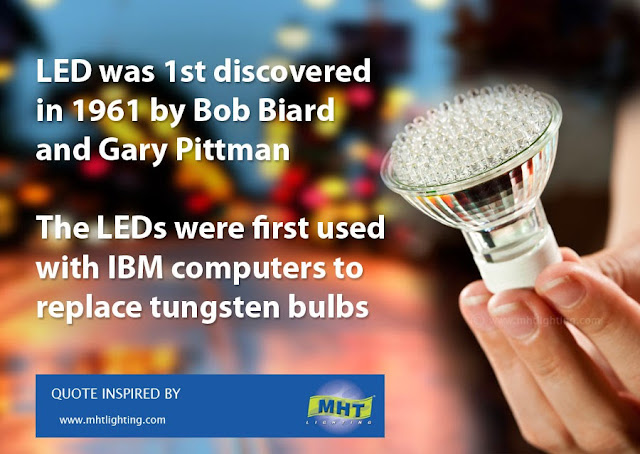
  •  LED was 1st discovered in 1961 by Bob Biard and Gary Pittman
  • The LEDs were first used with IBM computers to replace tungsten bulbs

uses of led lights in home

uses of led lights in home
  • LED is tougher than a bulb with filament
  • It is resistant to vibration and sudden impacts
  • LED uses semiconductors and electroluminescence to create light

Key benefits of LED’s

Key benefits of LED’s
  • Typical LED requires only 30-60 milliwatts to operate
  • Durable and shockproof unlike glass bulb lamp
  • Reduces stray light pollution on streetlights